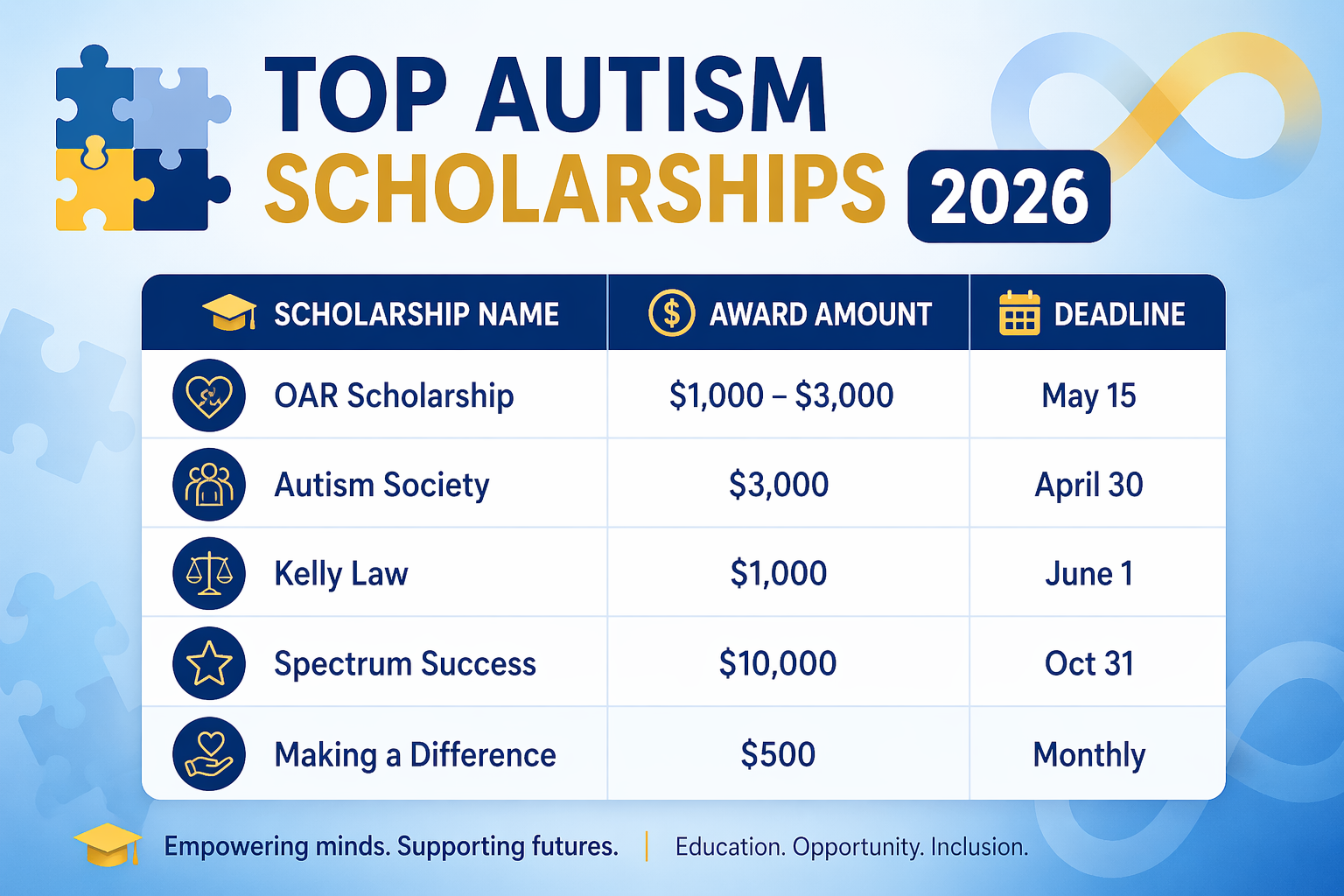
What is an autism scholarship? It is free money set aside specifically for students with Autism Spectrum Disorder (ASD). Unlike ordinary academic awards, these autism scholarships in 2026 focus less on perfect test scores and more on the unique journey, challenges, strengths, and potentials of the autistic learners.
Every year, thousands of dollars in autism scholarships go unclaimed; not because there are no qualified students to claim them, but because they simply never find them.
Meanwhile, families continue to struggle with rising tuition costs, unaware that there are dedicated autism scholarships and grants that are specifically designed to ease that burden. But you’re about to find out the goldmine that has been under your nose.
Here’s the truth you must know: most of these opportunities are hidden in plain sight.
And in 2026, more organizations than ever are funding scholarships for students with autism, but only those who know where to look and how to apply strategically actually benefit.
In this guide, you’ll discover exactly how to find, qualify for, and win these scholarships without confusion. By the end, you will have a clear roadmap to secure funding for special students living with autism.
What Are Autism Scholarships?
An autism scholarship is a financial award specifically designed for students diagnosed with Autism Spectrum Disorder (ASD). Unlike general academic scholarships, these funds recognize the unique challenges and strengths of autistic learners.
However, not all autism scholarships look the same. Some are purely need-based, while others reward qualities like academic achievement, community involvement, or career goals. The term autism scholarships and grants often covers both merit-based scholarships and need-based grants. Therefore, you should apply for both types to maximize your chances.
Why Are These Scholarships So Important Right Now?
Several factors make autism scholarships in 2026 a critical resource:
- Rising Diagnosis Rates: The Centre for Disease Control (CDC) now estimates that 1 in 36 children has autism spectrum disorder (ASD). And more students mean more demand for financial aid.
- Higher Education Costs: Tuition has risen over 150% in the last two decades, and learners with special needs are more affected because of the added cost of medical attention and specialized materials. Therefore, families need every dollar they can find to help alleviate such a burden.
- Unique Support Needs: Autistic students often require accommodations like quiet dormitories, tutoring, or assistive technology. Just like we briefly highlighted on the previous line, affording these supports would be difficult for families without scholarships and grants to cover these extras.
- Untapped Funding: Many scholarships for students with autism spectrum disorders receive very few applicants because most people do not know that such funding opportunities exist. Therefore, your odds of winning are often better than with general scholarships.
Meanwhile, awareness of neurodiversity is growing. More corporations and foundations now specifically fund scholarships for autism spectrum disorders because they recognize the value of diverse thinkers in the workforce.
The Main Types of Autism Scholarships
Understanding the different categories will help you target the right opportunities with increased chances of winning. Here is the breakdown:
1. National Nonprofit Scholarships
These are large, well-funded awards from organizations like the Organization for Autism Research (OAR) or the Autism Society. They are competitive but offer substantial amounts that range from $1,000 to $10,000.
2. State-Specific Grants and VR Funding
Every US state has a Vocational Rehabilitation (VR) agency, and many of them offer fully funded scholarships for disabled students, including full tuition coverage at community colleges and state universities. These are often overlooked, so you should prioritize them.
3. University-Based Autism Scholarships
Dozens of colleges have dedicated autism support programs that include internal scholarships for students. So, if you already know which school you want to attend, check its disability services office.
4. Micro-Scholarships
These smaller awards that are often under $1,000 have fewer applicants and a simpler application process. They are perfect for building momentum and stacking multiple awards. Do not hesitate to take advantage of these offers and apply for as many as you are qualified for.
5. Trade and Vocational Scholarships
Not all scholarships for autism students require a four-year degree or formal academic qualifications. Many fund certificate programs in Industrial Training, welding, culinary arts, or graphic design. Therefore, do not limit yourself to traditional colleges; explore every opportunity available
Top Scholarships for Students with Autism in 2026
Below is a curated list of the best opportunities you could find. Each entry includes a direct link to the official website so you can start your autism scholarship application today.
1. Organization for Autism Research (OAR) Scholarship
| Category | Details |
|---|---|
| Scholarship Name | Organization for Autism Research (OAR) Scholarship |
| Award Amount | $1,000 – $3,000 |
| Application Deadline | May 15, 2026 |
| Eligibility Requirements | • You must have a formal medical diagnosis of Autism Spectrum Disorder (ASD). • You must be a US citizen or legal resident. • You must have been accepted to an accredited school (college, university, or trade/vocational program). • You must have a GPA of 2.5 or higher. |
| How to Apply | Submit either: • A 2–3 minute personal video, or • A 1,000-word essay. Your submission must answer this question: “How will your education impact the autism community?” |
| Apply | https://researchautism.org/oar-scholarship/ |
The OAR Scholarship is widely considered the gold standard for autism scholarships in 2026 for a reason. Founded by the Organization for Autism Research, this prestigious opportunity stands out because it prioritizes real-world impact over raw academic metrics. Unlike many other awards that only look at GPA, the OAR Scholarship asks one powerful question: How will your education make a difference for the autism community? These awards are given to students attending two-year colleges, four-year universities, or vocational trade programs, which means you do not need a traditional degree path to qualify. Therefore, whether you are studying to become a welder, a nurse, or a software engineer, the OAR Scholarship recognizes your potential to contribute.
2. Autism Society – Schwallie Family Scholarship
| Category | Details |
|---|---|
| Scholarship Name | Autism Society – Schwallie Family Scholarship |
| Award Amount | $3,000 |
| Application Deadline | April 30, 2026 |
| Eligibility Requirements | • You must have a formal ASD diagnosis. • You must be a US resident. • You must be enrolled in or accepted to an accredited post‑secondary program. • No minimum GPA is required. |
| How to Apply | Complete the online application through the Autism Society portal. You will need two letters of recommendation: one academic and one personal. |
| Apply | https://www.autism-society.org/get-involved/scholarships/ |
The Schwallie Family Scholarship is one of the longest-running scholarships for autism spectrum disorders and carries the trusted reputation of the Autism Society of America. What makes it special? Unlike many awards that demand an excellent transcript, this scholarship focuses on your potential to succeed in post‑secondary education, whether it is a four‑year university or a community college certificate. So, if your grades do not tell the whole story, this is an excellent opportunity for you. Past winners have included students in culinary arts, graphic design, and liberal arts. However, do not wait too long: the April 30 deadline comes quickly.
3. Kelly Law Registry Autism Scholarship
| Category | Details |
|---|---|
| Scholarship Name | Kelly Law Registry Autism Scholarship |
| Award Amount | $1,000 (renewable for one year if you maintain a 2.5 GPA) |
| Application Deadline | June 1, 2026 |
| Eligibility Requirements | • You must be a US resident. • You must have a formal ASD diagnosis. • You must be a high school senior or a current college student. • No minimum GPA is required for the initial award. |
| How to Apply | Submit a 500‑word essay and a 60‑second video summary explaining how autism has shaped your life goals. |
| Apply | https://www.kellylawregistry.com/autism-scholarship |
The Kelly Law Registry Autism Scholarship is best for students who enjoy telling their story through both writing and video. Because it requires a short video as part of the application process, many applicants feel intimidated by this, but that works in your favor. Fewer applicants mean higher odds for you. The 500‑word essay is also shorter than most, so you can complete the entire application in an afternoon. Meanwhile, the renewable feature is a hidden gem: if you win as a freshman, you can receive the award again as a sophomore as long as your GPA stays above 2.5. That turns $1,000 into $2,000 over two years.
4. Avonte Oquendo Memorial Scholarship for Autism Safety
| Category | Details |
|---|---|
| Scholarship Name | Avonte Oquendo Memorial Scholarship |
| Award Amount | $1,000 |
| Application Deadline | July 15, 2026 |
| Eligibility Requirements | • You must be a student with ASD or a sibling of someone with ASD. • You must propose a community safety project. • No citizenship or GPA requirement is specified. |
| How to Apply | Submit a 750‑word written proposal describing your safety initiative. |
| Apply | https://www.avonteoscholarship.org/ |
This scholarship is unique because it asks you to do something, not just write about yourself. Named in memory of Avonte Oquendo, a young autistic boy who wandered from his school, this award funds students who want to prevent similar tragedies. Therefore, your proposal could be anything from a community awareness campaign to a low‑cost tracking device idea. You do not need to be an engineer or a policy expert to benefit, just someone who cares about safety. Because the application is project‑based, it attracts creative, action‑oriented students. If you have ever thought, “Someone should fix this,” this is your chance to be that someone.
5. Making a Difference for Autism Scholarship
| Category | Details |
|---|---|
| Scholarship Name | Making a Difference for Autism Scholarship |
| Award Amount | $500 |
| Application Deadline | Last day of every month (rolling) |
| Eligibility Requirements | • You must be an autistic student in the US or Canada. • No minimum GPA is required. • No formal diagnosis proof is required to apply. |
| How to Apply | Fill out a simple online form and write a 100‑word “Why I deserve this” statement. |
| Apply | https://www.makingadifferenceforautism.com/scholarship |
Do not overlook smaller awards; many people make this mistake. The Making a Difference scholarship is the perfect starting point for your autism scholarship application journey. Why? Because the 100‑word statement is so short that perfectionism cannot stop you. Moreover, it is awarded monthly, so if you do not win in January, you can try again in February. But, because the application is simple, many people rush through it. Take 20 extra minutes to make your 100 words specific, personal, and memorable. Mention a real moment when you made a difference for someone else, or when someone made a difference for you. That authenticity wins.
6. Autism Unbound Scholarship for Adult Learners
| Category | Details |
|---|---|
| Scholarship Name | Autism Unbound Scholarship |
| Award Amount | $2,500 |
| Application Deadline | August 20, 2026 |
| Eligibility Requirements | • You must be age 25 or older. • You must have a formal ASD diagnosis. • You must be enrolled in or accepted to a college or trade program. • No GPA requirement. |
| How to Apply | Submit proof of employment history (if any) and a 600‑word statement of purpose. |
| Apply | https://www.autismunbound.org/scholarship |
Most autism scholarships and grants target traditional students right out of high school. However, Autism Unbound was created specifically for adults who are returning to education later in life. Whether you were diagnosed late, took time off to work, or raised a family first, this scholarship says: Your journey is valid. The 600‑word statement of purpose is your chance to explain why now is the right time for you to go back to school. Therefore, be honest about gaps in your education. Did burnout force you to leave college at 20? Say that. Did you spend ten years in a job that taught you resilience? Mention it. Adult learners bring lived experience that younger students simply do not have—and this scholarship values that.
7. State Vocational Rehabilitation (VR) Tuition Grants
| Category | Details |
|---|---|
| Scholarship Name | State Vocational Rehabilitation (VR) Tuition Grant |
| Award Amount | Up to $10,000 per year |
| Application Deadline | Open for enrollment |
| Eligibility Requirements | • You must have a documented ASD diagnosis that creates a barrier to employment. • You must be a US citizen. • Income limits vary by state, but many are generous. |
| How to Apply | Contact your state VR agency directly. Say: “I am an autistic student seeking financial support for college or vocational training.” |
| Official Link | https://www.rehabnetwork.org/ |
This is the most underutilized fully funded scholarship for disabled students in the United States. Unlike traditional scholarships that require essays and videos, VR grants are based on your need for support to gain employment. Because autism often creates barriers in interviews, social communication, or executive functioning, most autistic students qualify. So, what can you get in these grants? Full tuition at a community college, up to $1,200 for a laptop, gas cards for transportation, and even funding for noise‑canceling headphones. However, the process requires patience: you will need to meet with a counselor, provide medical records, and create an employment plan. Start now, because the entire process can take 60–90 days. But once approved, the funding is life‑changing.
8. Spectrum Success Scholarship (SSS)
| Category | Details |
|---|---|
| Scholarship Name | Spectrum Success Scholarship |
| Award Amount | $10,000 (single winner) |
| Application Deadline | October 31, 2026 |
| Eligibility Requirements | • You must have a formal ASD diagnosis. • You must have a 3.2 minimum GPA. • You must be enrolled in a STEM major (cybersecurity, data science, or IT preferred). |
| How to Apply | Solve a logic puzzle on their website. This replaces the traditional essay. |
| Apply | https://www.spectrumsuccess.org/2026-scholarship |
Brand new for 2026, the Spectrum Success Scholarship is one of the largest single awards on this list. But here is what makes it truly different: instead of writing an essay, you solve a logic puzzle. This is brilliant for many autistic students who struggle with open‑ended writing but excel at pattern recognition and systematic thinking. Therefore, if standardized tests or brain teasers are your strength, you have a real edge. The $10,000 prize goes to just one winner, so the competition will be fierce. However, because the application is unusual, many students will not even try. Be the one who does. Set a calendar reminder for October 31, 2026, and practice logic puzzles from sites like Brilliant.org or Khan Academy.
9. Lorna Wing Memorial Grant
| Category | Details |
|---|---|
| Scholarship Name | Lorna Wing Memorial Grant |
| Award Amount | $1,000 |
| Application Deadline | September 1, 2026 |
| Eligibility Requirements | • You must be open worldwide (no US citizenship required). • You must have a formal ASD diagnosis. • You must be pursuing an arts‑related degree or certificate (music, writing, visual arts). |
| How to Apply | Submit a portfolio of 5–10 works and a 400‑word artist statement. |
| Apply | https://www.lornawinggrant.org/ |
Most scholarships for autism students are limited to US citizens. But the Lorna Wing Memorial Grant is open to applicants from any country, making it a rare gem for international readers. Named after Dr. Lorna Wing, the psychiatrist who popularized the term “Asperger’s syndrome,” this grant celebrates creativity. Therefore, if you express yourself better through painting, poetry, fiction, music composition, or digital art, this is your chance. The portfolio does not need to be professional; it just needs to be authentically yours. Meanwhile, the 400‑word artist statement should explain how autism influences your creative process. For example, do you notice details others miss? Do you use art to communicate emotions that are hard to speak about? Share that.
10. Doug Flutie Jr. Foundation “Flutie Fund” Grant
| Category | Details |
|---|---|
| Scholarship Name | Doug Flutie Jr. Foundation – Flutie Fund Grant |
| Award Amount | Up to $1,500 (for assistive technology or tuition‑related expenses) |
| Application Deadline | Rolling (funds often run out by October) |
| Eligibility Requirements | • You must be a student with ASD. • You must demonstrate financial need. • You must be a US resident. • No GPA requirement. |
| How to Apply | Complete the online form and have a therapist or doctor sign the “need for technology” section. |
| Apply | https://www.flutiefoundation.org/flutie-fund |
This is not a traditional tuition scholarship, but it can be just as valuable. The Flutie Fund Grant pays for assistive technology that helps you succeed in school. Think noise‑canceling headphones, text‑to‑speech software, an iPad with AAC apps, or even a laptop with specialized ergonomic features. Therefore, if you already have a scholarship covering tuition, this grant fills the gaps. Because the deadline is rolling, you should apply as early as possible. Funds typically run out by October. So, do not wait until the middle of the semester. The application requires a signature from a therapist or doctor, so plan and ask your provider at your next appointment.
Eligibility Requirements for Autism Scholarships in 2026
Before you begin your autism scholarship application, verify these common requirements:
1. Diagnosis Proof
Most awards require a formal letter from a psychologist, psychiatrist, or licensed therapist to confirm your disability. An Individualized Education Program (IEP) or 504 plan can also be accepted, but read the fine print. Some scholarships accept a letter from a school counselor.
2. Enrollment Status
Many autism scholarships and grants accept part-time students. However, some require full-time enrollment. If you plan to study part-time, filter for scholarships that explicitly allow it.
3. Citizenship
The majority of US-based scholarships for autism students require a Social Security number or a green card. But a few private funds accept DACA recipients or international students on F-1 visas. The Lorna Wing Grant is open globally.
4. Age Limits
While many scholarships are for “traditional” students between 18 and 22, the Autism Unbound scholarship and VR grants have no upper age limit. Therefore, do not assume you are too old.
Required Documents for Your Autism Scholarship Application
Gather these items before you start. It will save you weeks of stress and last-minute scrambling.
- Clinical diagnosis letter, which can be redacted for privacy, but must show the ASD diagnosis code
- Unofficial transcripts, often a PDF from your school portal; most scholarships do not require official sealed copies
- Two letters of recommendation: one academic from a teacher, one personal from a mentor, employer, or therapist
- FAFSA Submission Summary, for need-based awards; you can file the FAFSA even if you are not sure you qualify
- A “master essay”, like some programs that require 800–1,000 words about your journey with autism, your strengths, and your educational goals
Create a folder on your computer or cloud drive named Autism Scholarship in 2026 – [Your Name]. Store all these documents there so you can quickly upload them for different applications.
How to Apply for Autism Scholarships
Following this exact sequence will reduce overwhelm and increase your success rate.
1. Create a Dedicated Scholarship Email Address
Use something like [Firstname].[Lastname]Autism2026@gmail.com. This keeps scholarship notifications separate from personal spam. Therefore, you will never miss a deadline.
2. Build a Tracker
Include columns for: Scholarship Name, Deadline, Award Amount, Documents Required, Status (Not Started / In Progress / Submitted / Won).
3. Request Letters of Recommendation Early
Ask at least three weeks before the first deadline. Provide your recommenders with your resume, your “master essay,” and a list of scholarships you are applying for. So, they can write specific, personalized letters.
4. Complete the Smallest Application First
Start with the $500 monthly “Making a Difference” scholarship. It has a simple 100-word statement. Winning or even just finishing a small award builds momentum.
5. Adapt Your Master Essay for Each Application
Do not submit the same generic essay everywhere. Adjust the opening paragraph to address the specific mission of each scholarship. For example, for the Avonte Oquendo scholarship, emphasize safety and advocacy. For the OAR scholarship, focus on community impact.
6. Record a Video Draft (If Required)
Many autistic students prefer writing, but video scholarships often have 50% fewer applicants. Use your phone to record a 2–3 minute clip. You do not need professional editing. Just speak clearly about your goals and how the scholarship will help.
7. Submit at least 72 Hours Before the Deadline
Do not wait until 11:59 PM on the final day. Servers crash, the internet may fail, and stress spikes. Therefore, submit early.
Insider Tips to Increase Your Chances
Having reviewed hundreds of scholarships for autism spectrum applications, here is what actually works:
- Be specific about your autistic traits. Instead of saying “I struggle with social situations,” say “I use a written communication checklist for group projects, which has made me the most organized team member.”
- Quantify your special interest. Love trains? Say “I built a database of 200+ train schedules, which taught me data management.” Love video games? “I moderate a Discord server of 500 members, developing conflict resolution skills.”
- Do not hide your diagnosis. Scholarship committees want to fund autistic students. Use identity-first language (“autistic student”) unless the application specifies otherwise.
- Apply for local scholarships first. Your town’s autism support group, county disability board, or regional community foundation often has less competition than national awards.
- Reuse your materials. The same 800-word essay can be slightly tweaked for 10 different autism scholarships in 2026.
- Ask for feedback on tone. Autistic writers can sometimes come across as too blunt or literal. Have a neurotypical friend or teacher read your essay for tone.
- Follow up politely. If you have not heard back by the notification date, send a brief email. Sometimes committees have leftover funds or make mistakes.
- Apply for need-based awards even if you think your family earns too much. You might be surprised. Many autism scholarships and grants have higher income limits than you expect.
- Consider part-time enrollment. If you cannot handle a full course load, many scholarships still accept part-time students. Therefore, do not let full-time requirements discourage you.
Common Mistakes to Avoid
Avoid these pitfalls to ensure your autism scholarship application is not rejected instantly.
1. Writing a “pity” essay: Committees dislike “Autism ruined my life” narratives. Instead, focus on specific obstacles and how you overcame them.
2: Ignoring the word limit: If the limit is 500 words, 498 is perfect. 650 will be discarded without reading.
3: Applying only to national scholarships: The competition is fierce. Local scholarships for autism spectrum disorders often have only 10–20 applicants.
4: Forgetting to proofread: Run your essay through Grammarly or have a friend check for typos and clarity.
5: Missing the “hidden” eligibility rules: Some scholarships require a minimum GPA of 2.5, exclude graduate students, or require a specific major. Read everything twice.
6: Submitting at the last minute: Technical glitches happen. Submit at least 48–72 hours early.
Best Universities for Autistic Students
Applying to a neurodiversity-friendly college increases your chances of receiving internal funding. These schools have dedicated autism support programs and often offer scholarships for autism spectrum disorders to enrolled students.
| University | Support Program | Annual Scholarship Amount |
|---|---|---|
| University of Montana | MOSSAIC Program | $2,000 |
| Rochester Institute of Technology (RIT) | Spectrum Support Program | Varies (up to $5,000) |
| Bellevue College (WA) | Neurodiversity Navigators | $500–$1,000 |
| Marshall University (WV) | College Program for Students with ASD | Tuition waiver (need-based) |
| Eastern Michigan University | Autism Collaborative Center | $1,500 |
| Landmark College (VT) | An entire college designed for neurodivergent students | Merit scholarships up to $8,000 |
Resource: Visit the College Autism Network for a searchable database of 200+ supportive schools.
How to Find More Autism Scholarships
Do not rely only on this guide. Use these exact Google search strings to uncover hidden awards:
"autism scholarship" 2026 filetype:pdf"scholarships for autism spectrum" -medical -therapy"neurodiversity scholarship" undergraduate"ASD grant" vocational training"autism scholarships and grants" rolling deadline
Set up a Google Alert for the phrase autism scholarships 2026. You will receive an email whenever a new scholarship is posted. This gives you a first-mover advantage.
Frequently Asked Questions
Can I get an autism scholarship if I was diagnosed later in life (age 30+)?
Absolutely. The OAR Scholarship, Autism Unbound Scholarship, and state VR grants have no upper age limit. You simply need a formal diagnostic report from a psychologist.
Do I have to disclose my autism on the college application itself?
No. You can apply for scholarships for autism students separately without disclosing on the Common App. However, disclosing can help you get accommodations (quiet dorms, extended test time, note-taking assistance).
Are there autism scholarships for international students studying in the USA?
Yes, but fewer. The Lorna Wing Memorial Grant is open globally. For US-specific federal aid, you generally need a green card or citizenship. But some private universities have internal funds for international disabled students. Contact the disability services office at your target schools.
What if I don’t have a formal diagnosis (self-diagnosed)?
Most legitimate autism scholarships in 2026 require a doctor’s signature. Therefore, if you are self-diagnosed, apply for “neurodiversity” scholarships instead, which are often more flexible. Also consider seeking a formal diagnosis through a sliding-scale clinic.
Can I use the money for a laptop or therapy instead of tuition?
It depends on the award. OAR allows funds for “education-related expenses,” which include laptops, software, and noise-canceling headphones. But the Kelly Law Registry requires the check to be sent directly to the university for tuition only. Read the terms carefully.
How many scholarships should I apply for?
Aim for 15–20 applications. Each one takes 1–3 hours. Therefore, if you dedicate one weekend per month, you can complete 5 applications per month. Over six months, that is 30 applications – and statistically, you will win at least 2–3.
Is there a central official website for all autism scholarships?
Not a single one, but the Autism Society of America maintains a reliable, updated list. Start there: Autism Society Scholarship Page. Also, bookmark the OAR page: https://researchautism.org/oar-scholarship/
Start Your Autism Scholarship Application Today
You now have everything you need: a curated list of the best autism scholarships in 2026, a step-by-step application process, insider tips, and direct links to official websites. The only missing piece is your action.
Do not let perfectionism stop you. Your essay does not need to be Pulitzer Prize-winning. Your video does not need Hollywood editing. It just needs to be you – honest, specific, and determined.
Start now. Pick one scholarship from the list above. The $500 monthly award is the easiest entry point. Complete the 100-word statement today. Once you submit that first application, the rest become easier.
Remember: every dollar you win is a dollar you do not have to borrow. Autism scholarships and grants are waiting for you. Go claim them.
Don’t miss this opportunity. Bookmark this page, download the checklist, and begin your autism scholarship application tonight. Your future self will thank you.